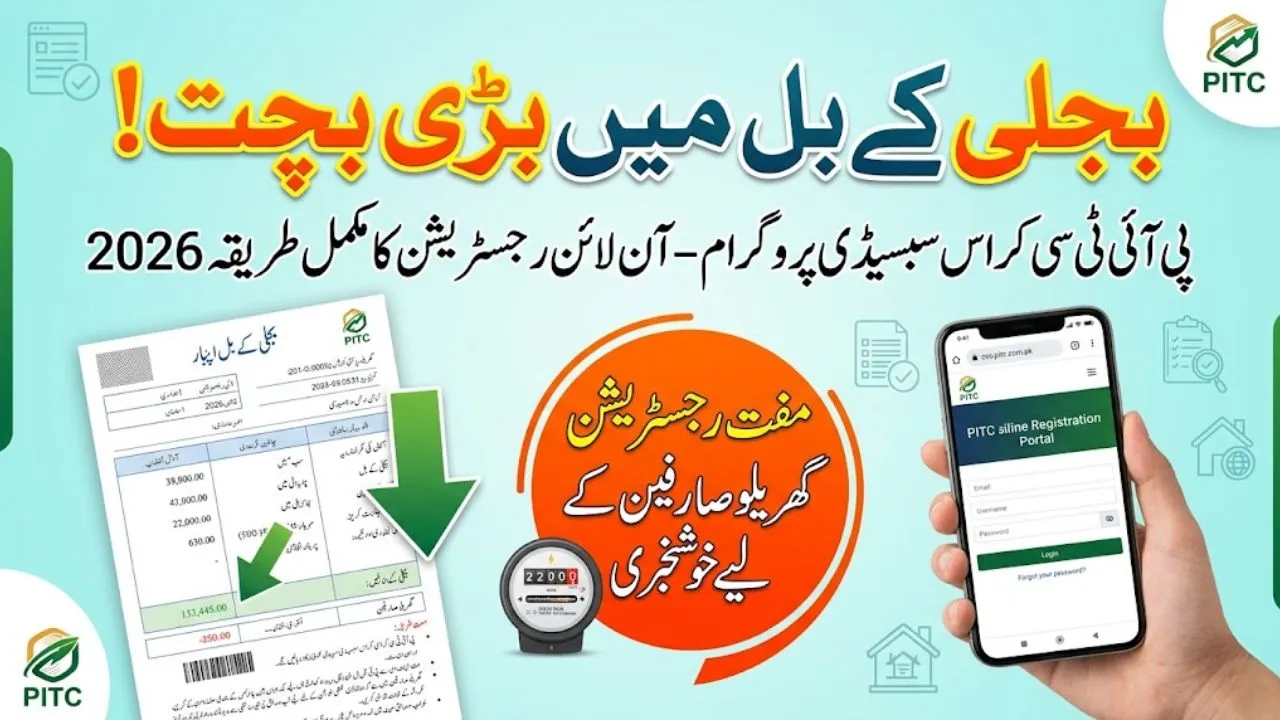
Electricity bills in Pakistan keep climbing every year, and for most households, cutting back on fans, lights, and appliances still isn’t enough to keep the bill manageable. To help low-usage families, the Cross Subsidy Program (CSS) is run by PITC (Power Information Technology Company) — a fully digital system that checks who genuinely qualifies for a cheaper electricity rate and applies the discount directly to their bill.
This guide covers everything: what the program is, who qualifies, the full registration process, which electricity companies are covered, how the discount actually shows up on your bill, common problems, and how to avoid scams.
Quick Overview
| Detail | Information |
| Program name | Cross Subsidy Program (CSS) |
| Run by | Power Information Technology Company (PITC) |
| Official website | css.pitc.com.pk |
| Who it’s for | Domestic (residential) electricity consumers |
| Registration fee | Free — no charges at any stage |
| Renewal needed? | No — stays active automatically while you remain eligible |
| Covers | LESCO, FESCO, GEPCO, IESCO, MEPCO, HESCO, PESCO, QESCO, SEPCO, TESCO |
| Last date | No fixed deadline — open year-round, rechecked every billing cycle |
What Is the Cross Subsidy Program (CSS)?
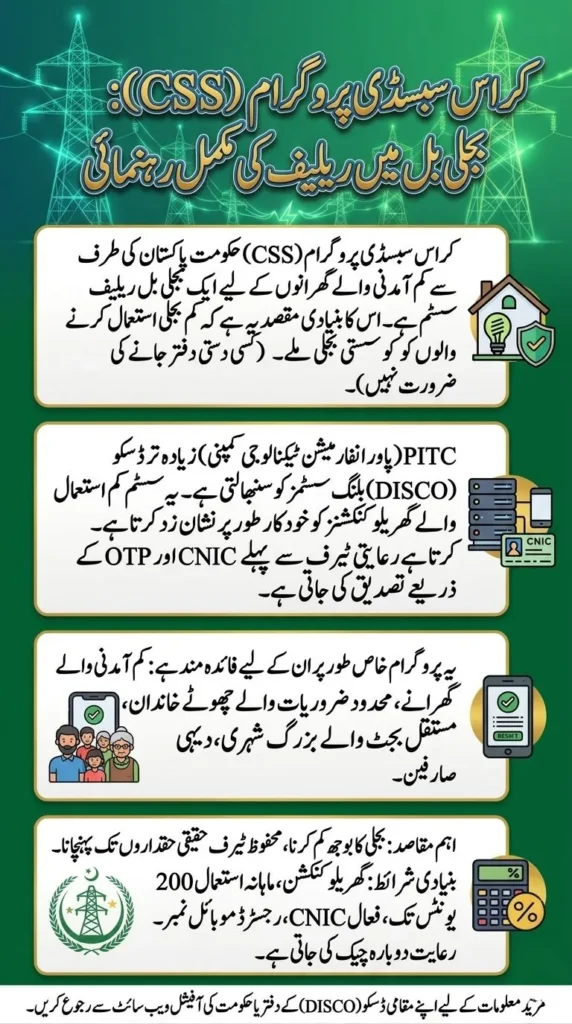
CSS is a government electricity relief system built around one simple idea: households that use very little electricity should pay a lower rate per unit — and that lower rate should actually reach the families it’s meant for.
PITC manages the billing systems for most of Pakistan’s electricity distribution companies (DISCOs), processing millions of bills every month. Using this existing billing data, CSS automatically flags low-usage domestic connections and verifies them through CNIC and mobile OTP before applying the protected, discounted tariff.
In simple terms: lower usage + verified identity = a cheaper rate on your next bill, with no manual office visit required.
This program is especially useful for:
- Low-income households
- Small families with limited electricity needs
- Senior citizens managing a fixed monthly budget
- Rural consumers facing rising electricity costs
- Anyone already living within the protected consumption limit
Why an Electricity Subsidy Program Like This Matters
Summer in Pakistan means heavier bills — fans, coolers, refrigerators, and ACs push consumption up fast. Even families using only basic appliances can end up with a bill that’s hard to manage on a typical salary.
A targeted subsidy program solves a fairness problem too: instead of giving the same discount to everyone (including people who don’t need it), CSS rewards genuinely low-usage households while higher consumers continue paying standard rates.
Main goals behind the program:
- Easing the electricity burden on low-income households
- Making sure the protected tariff reaches real, deserving consumers
- Encouraging careful, lower electricity usage
- Reducing manual paperwork and processing delays
- Cutting out middlemen and fraudulent “agents”
Who Is Eligible? (Basic Requirements)
PITC doesn’t just look at your last bill — it checks several conditions together before approving subsidy status.
| Requirement | Details |
| Connection type | Domestic / residential only |
| Monthly usage | Typically around 200 units or below |
| CNIC status | Valid and currently active |
| Mobile number | Registered, working, and reachable for SMS |
| Electricity company | Must be a PITC-covered DISCO |
| Number of connections | Only one domestic connection per CNIC |
A few extra points worth knowing:
- The connection must be residential — commercial, industrial, or agricultural meters don’t qualify.
- Your account details (name, address) must match official billing records.
- Bills on the connection should be reasonably up to date, without major unpaid dues.
- Eligibility is checked again each cycle — if your usage rises one month, the discount may pause until usage drops back down.
How PITC Verifies Your Eligibility
When you enter your reference number on the portal, PITC runs an automatic check before letting you proceed. This is what keeps the system fair and reduces fraudulent registrations.
The system typically checks:
- Monthly consumption history (the rolling average, not just one bill)
- Whether the tariff category is domestic
- CNIC validity
- Mobile number status (it needs to be reachable for an OTP)
- Whether the same CNIC already has another active domestic connection registered
If any of these checks fail, the portal shows an error instead of moving you to registration — that’s usually a sign something needs fixing first (at your DISCO office, or with your mobile number).
Css pitc com pk Registration: Step-by-Step
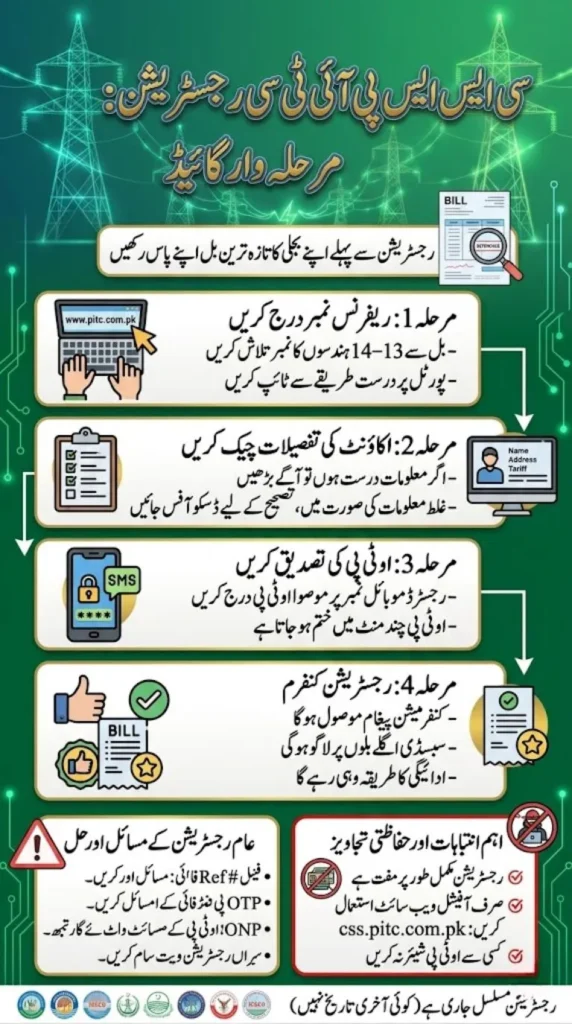
Keep your latest electricity bill close by — you’ll need the reference number from it.
Step 1 — Find your reference number It’s usually a 13–14 digit number printed near the top of your bill. Type it carefully on the official portal — even one wrong digit causes an error.
Step 2 — Check your account details If your connection qualifies, the portal shows your account info:
- Consumer name
- Address
- Electricity company
- Tariff category
- Connected load
If anything here is wrong, stop and get it corrected at your local DISCO office before continuing — registering with incorrect details can cause problems later.
Step 3 — Verify with OTP The system sends a one-time password (OTP) to the mobile number linked with your account. This step confirms that you’re really the account holder.
A few notes on OTP:
- It expires after a few minutes — resend if it doesn’t arrive in time
- Your SIM should be active and PTA-verified
- Repeated wrong OTP entries can temporarily lock the verification step
Step 4 — Registration confirmed Once OTP verification succeeds, you’ll see a confirmation message. From here:
- The subsidy applies automatically on future bills
- No monthly renewal is needed
- You keep paying your bill exactly as before — just at the lower rate
- Benefits continue as long as you stay within the eligibility conditions
That’s the entire css pitc com pk apply online registration process — usually a couple of minutes if your details are correct on the first try.
PITC Portal: Don’t Confuse These Three Sites
A lot of people searching “PITC Portal” or “Pitc com pk login register” end up on the wrong page. Here’s the difference:
| Website | What it’s actually for |
| css.pitc.com.pk | Cross Subsidy Program registration (this guide) |
| www.pitc.com.pk | General company information about PITC |
| CCMS (ccms.pitc.com.pk) | Filing or tracking an electricity complaint, not subsidy |
If you searched “CCMS PITC com pk” hoping to register for the subsidy, that’s actually the complaints system — CSS is the one you want.
Cross Subsidy Program MEPCO and Other DISCOs Covered
CSS works the same way no matter which company sends your bill. The following DISCOs are covered:
| DISCO | Full Name |
| LESCO | Lahore Electric Supply Company |
| IESCO | Islamabad Electric Supply Company |
| FESCO | Faisalabad Electric Supply Company |
| MEPCO | Multan Electric Power Company |
| GEPCO | Gujranwala Electric Power Company |
| PESCO | Peshawar Electric Supply Company |
| HESCO | Hyderabad Electric Supply Company |
| SEPCO | Sukkur Electric Power Company |
| QESCO | Quetta Electric Power Company |
| TESCO | Tribal Electric Supply Company |
K-Electric consumers in Karachi are generally not part of this system, since K-Electric is a separate, privatized utility with its own billing setup outside the PITC-managed DISCO network.
How the Subsidy Actually Shows Up on Your Bill
A common misunderstanding: people think the subsidy means cash gets transferred to a bank account or mobile wallet. It doesn’t.
Instead, once you’re approved, your bill is simply calculated at the lower, protected rate — so the payable amount on your monthly bill is smaller. There’s no separate payment process to set up.
You keep paying through the same channels as always:
- Bank branches
- ATMs
- EasyPaisa / JazzCash
- Mobile banking apps
- DISCO payment centers
If your usage goes above the protected limit in any given month, the discount may pause for that one bill — but it typically resumes automatically once your usage drops back into range.
Common Registration Problems & How to Fix Them
| Problem | Likely Cause | Fix |
| “Invalid reference number” error | Wrong digits or extra spaces entered | Re-check the number on your physical bill carefully |
| OTP not received | SIM not active or not PTA-verified, or a network delay | Wait a couple of minutes, then resend; try a different verified number if needed |
| Mobile number mismatch | Number on file doesn’t match the one you’re using | Update your number through official DISCO channels first |
| Connection marked as commercial | Tariff category on record is wrong | Get it corrected at your DISCO office |
| High consumption history | Average usage is above the protected limit | Reduce usage and try again next cycle |
Avoid repeatedly retrying with wrong information — too many failed attempts can temporarily block further verification.
Safety Tips: Avoid Fake “Cross Subsidy Program” Websites
Whenever a relief scheme like this gets popular, fake websites and scam agents show up too. Some people have lost money trusting “guaranteed approval” offers that don’t actually come from PITC.
Keep these basics in mind:
- Registration is completely free — no fee at any step
- Only use css.pitc.com.pk — type it yourself rather than clicking random links
- Never share your OTP with anyone over a call or message
- Ignore WhatsApp messages offering “paid registration” or “fast-track approval”
- Don’t pay any agent, shopkeeper, or middleman to register on your behalf
Consumers in smaller towns and villages should be extra cautious, since scammers often target people less familiar with how the official system works.
Cross Subsidy Program Last Date 2026
There’s no single closing date after which the program shuts down. Registration stays open continuously, and PITC re-checks your usage every billing cycle.
The only timing that matters is your DISCO’s monthly cut-off (usually around the 25th–28th):
- Register before the cut-off → discount may apply on your next bill
- Register after the cut-off → it applies on the bill after that
If you come across a post claiming the program is “closing soon,” treat it as unverified unless it’s confirmed directly through the official PITC portal.
Benefits of the Cross Subsidy Program
For many families, this discount makes a real difference to the monthly budget — freeing up money for groceries, school costs, or medicine.
Key advantages:
- Lower electricity bill amount
- Fully online — no office visits needed
- Transparent, automatic verification
- No renewal hassle once approved
- Completely free to register
- Encourages mindful, lower electricity usage
FAQs
Is css.pitc.com.pk free to use? Yes — checking eligibility and registering is free at every step.
Do I need to renew my registration every month? No. Once approved, it stays active automatically as long as you remain eligible.
My registration didn’t reflect on my bill — why? Check whether you registered before your DISCO’s monthly cut-off, and confirm your 6-month average is genuinely within the protected range.
Can commercial or shop connections apply? No, only domestic/residential connections qualify.
Is CCMS the same as CSS? No — CCMS handles complaints; CSS handles subsidy registration.
Final Words
The Cross Subsidy Program is one of the more practical digital relief tools available to low-usage electricity consumers in Pakistan right now. With just your reference number, CNIC, and an active mobile number, registration on css.pitc.com.pk takes only a few minutes — and if you qualify, the saving shows up automatically on your next bill, with nothing further to do as long as your usage stays within range.